Siena Cathedral: Floor, Pulpit and all its Wonders
Among the great works of medieval European sacred architecture, the cathedral of Siena certainly deserves a place of honor.
The first part of the construction was probably built in the second half of the 1100s, if we give credit to later reports that speak of its consecration in 1179 by Pope Alexander III, after the peace with Frederick Barbarossa.
However, other sources give the year 1195 as the one in which the construction work began, ending in 1215, and still others just 1215 as the beginning. What seems quite certain is that in the same place there was already a Catholic church, built in turn on the remains of a Roman temple dedicated to Minerva.
The different stages of construction
In any case, since 1226 we have documents that testify to the purchase of building materials.
In this regard, it must be remembered that the initial design changed several times, and the construction was expanded to include a series of buildings.
For example, a second and important phase of construction began in 1339, then interrupted by the Black Death of 1348 and subsequently resumed.
The different construction phases are for example evident in the facade, in white marble with serpentine and red decorations.
It can in fact be divided into two parts, the lower and the upper.
Inside, it is possible to admire architectural, sculptural and pictorial masterpieces ranging from the late 1200s to the mid-nineteenth century.
The floor
The floor was also built in many stages, and was only completely built in the nineteenth century.
The uniqueness of the floor of the Siena Cathedral lies in the fact that it is made up of 56 squares, with different subjects, completely made up of marble inlays, that is, sections of precious marble cut very thin, of a certain size, which are then juxtaposed to obtain the desired design.
A technique close to the mosaic but much more complex and difficult to implement.
Tradition has it that the work was conceived by the Sienese artist Duccio di Buoninsegna, the first teacher and founder of the Sienese school, who probably died in 1319.
We then have news of the construction of some panels in 1339, panels which were then replaced and of which we no longer have any trace.
The panels were created by many different artists, almost all from Siena, among which the name of Domenico Beccafumi, active in the first half of 1500, who composed 35 of them, stands out.
The pulpit
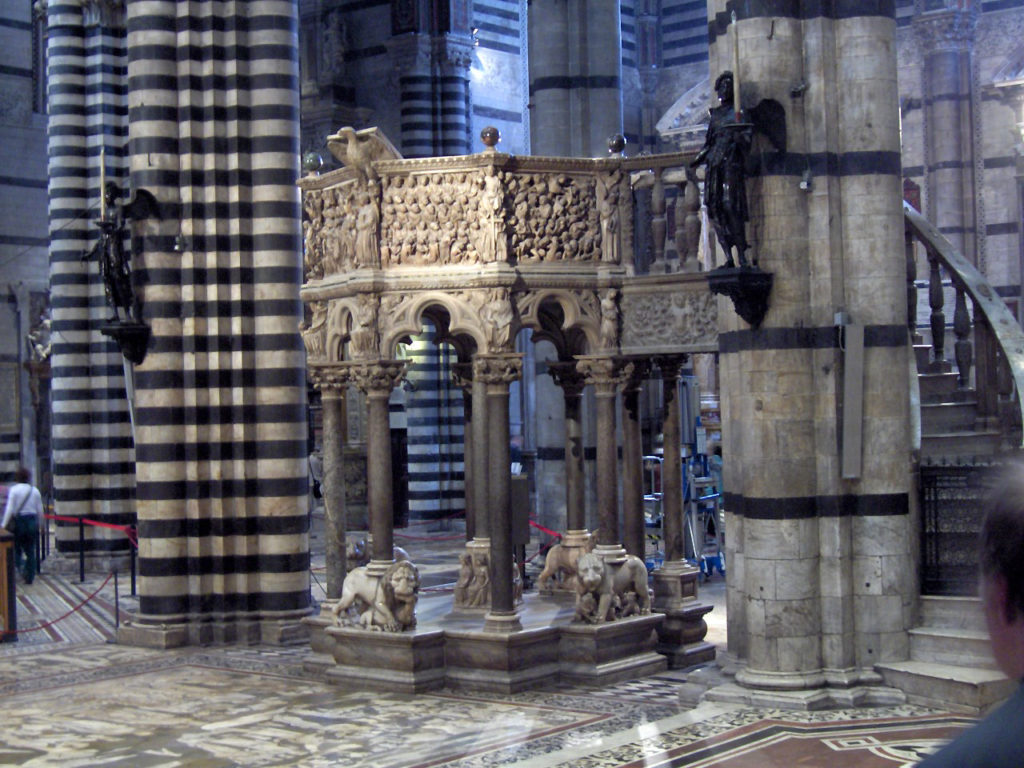
The pulpit, on the other hand, was created in the early years of the Cathedral’s life, it is believed between 1265 and 1268, by the artist Nicola Pisano.
It is the greatest example of Italian sacred sculpture of the period, and one of the greatest in the world.
It is accessed via a fairly wide staircase, has an octagonal plan and is supported by eight columns. Four of these are in turn resting on lions.
The side panels are entirely sculpted, with scenes from the life of Christ from birth to crucifixion; the last two scenes represent the universal judgment with the condemnation of the damned and the salvation of the elect.
Quick Booking snippet

Extra virgin olive oil is a natural product that continues to evolve after pressing. Heat, light and oxygen accelerate this process and gradually affect both flavour and quality. At Villa Campestri Olive Oil Resort, this is something we know well. Our family has been producing extra virgin olive oil for generations, using olives grown in […]
Mugello is best known for its charming villages, ancient woodlands, historic villas and quintessential Tuscan landscapes. What many people don’t realise is that, after sunset, its clear skies and low levels of light pollution create ideal conditions for observing constellations, planets and, at the right time of year, even the Milky Way stretching across the […]
Villa Campestri, the world’s first Olive Oil Resort, transforms extra virgin olive oil into an experience that brings together nature, gastronomy, wellbeing and a deep connection to the land.
Have you ever woken up in the morning feeling as tired as when you went to bed? Or found yourself exhausted at night, only to lie awake for hours? Perhaps you’ve experienced that familiar afternoon slump, when your energy suddenly disappears for no obvious reason. Most of us blame stress, a busy schedule or lack […]
One of the most meaningful experiences during a trip to Tuscany, beyond visiting art cities or iconic landscapes, is connecting with everyday local life. That connection often happens in village markets, artisan workshops, and small food shops where products are made for the people who live there year-round, not just for visitors. In this guide, […]
How to get to Mugello from Florence and how to travel around Tuscany with or without a car. Distances, trains, buses and transfers.
Romantic weekend in Tuscany between Mugello and Florence: scenic rooms, candlelight dinners, and olive oil tastings. Discover Villa Campestri Olive Oil Resort.
Anyone visiting Florence for the first time imagines a stay right in the historic center, surrounded by museums, piazzas, and narrow cobblestone streets. It takes only a day, however, to realize that Florence is wonderful to explore yet challenging to inhabit. Between ZTL restrictions, scarce and expensive parking, constant noise, and high prices for even […]