Notes of Architecture: the unmistakable Renaissance style
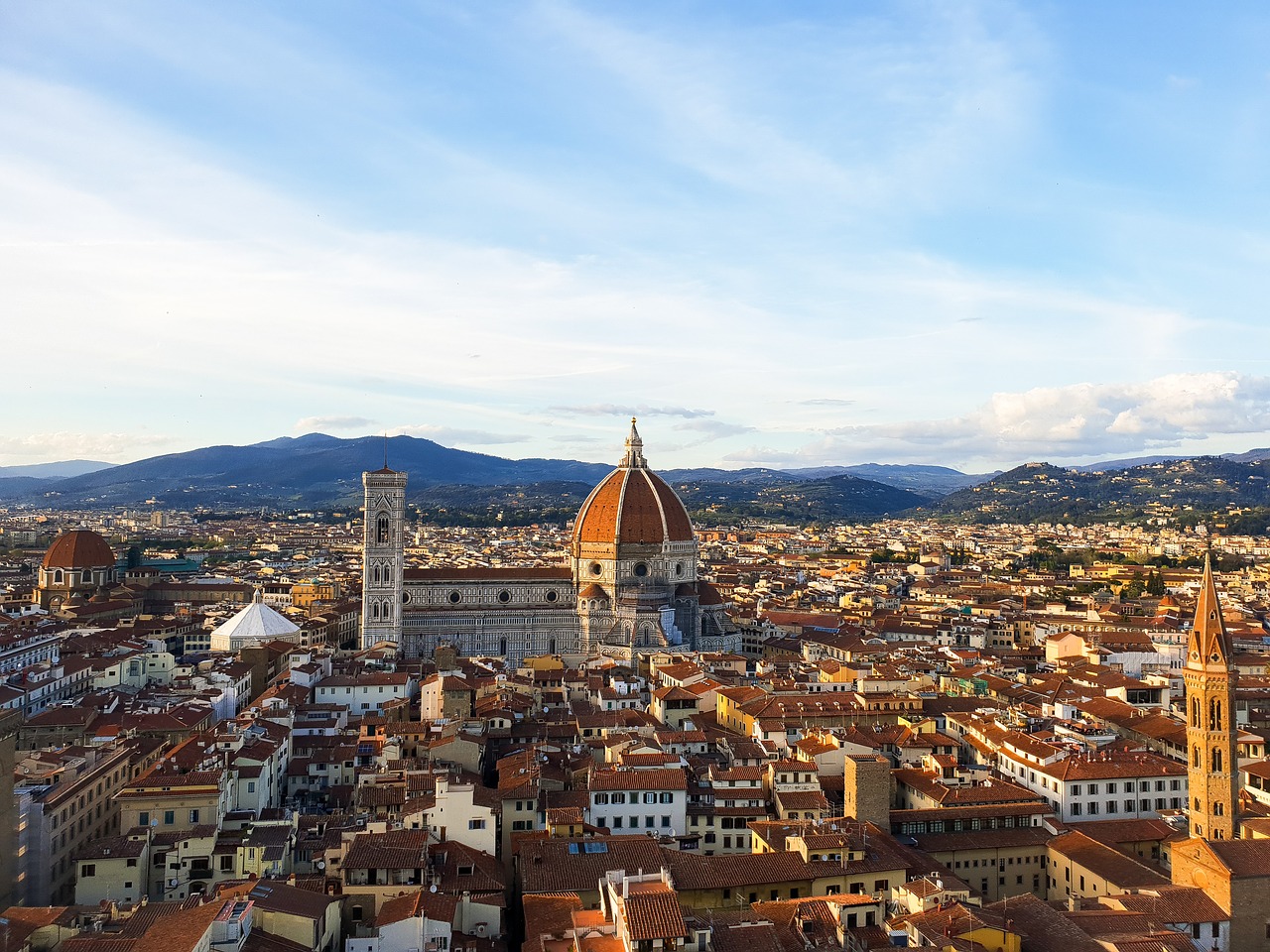
At the beginning of the 15th century Florence became the most powerful city in Tuscany and one of the richest and most important in Europe. It was then that in all the arts, including architecture, the unmistakable Renaissance style was born.
Renaissance style in architecture
The architecture of the Renaissance originated at the beginning of the fifteenth century in Florence, mainly thanks to the work of some artists and intellectuals such as Filippo Brunelleschi and Leon Battista Alberti.
Among the political and cultural factors that influenced this new direction of the arts there were the affirmation of the lordships and the development of Humanism, with the consequent antiquarian and philological taste, which in architecture translates into the study of the beautiful forms of ancient buildings, that is, Romans.
Although the movement is temporally well defined, inside it is possible to identify different stylistic moments, which critics identify in the “early Renaissance”, belonging to the fifteenth century, in the “Classical Renaissance” and in Mannerism, the latter both coinciding with the sixteenth century.
The protagonists of Renaissance architecture
Filippo Brunelleschi
Filippo Brunelleschi (1377-1446) is considered the “father of the Renaissance“. Brunelleschi began his career as a sculptor and in fact participated in the 1401 competition for the second door of the Baptistery of Florence: an event that marked the beginning of the Renaissance adventure. Later he decided to move to Rome to study ancient architecture with the aim of discovering the secrets of classical art.
In 1419, Brunelleschi designed the first orphanage in Europe, the Ospedale degli Innocenti. The building overlooks Piazza della Santissima Annunziata, with its elegant columned portico.
In 1420, Giovanni dei Medici commissioned Brunelleschi to design a funeral chapel for his family, in the early Christian Basilica of San Lorenzo.
With the Portico degli Innocenti and the Old Sacristy, Brunelleschi made one of the greatest revolutions in Western cultural history. Moreover, he was the first to create a new professional figure as an architect: no longer a consultant specialized among many artisans, but a true intellectual professional responsible for the entire executive process, which included the realization of details.
Leon Battista Alberti
Leon Battista Alberti (1404-1472) was one of the most important intellectual architect of the Renaissance. He was a man of boundless culture, capable of passing, without apparent effort, from literary studies to philosophical or philological and artistic studies.
He had the great merit of developing a solid theory of the new art and of the new Renaissance architecture, supporting the practice of colleagues, often conducted through attempts and experimentations, with rules derived from his studies of ancient texts.
Alberti was therefore a great artist but first of all a great theoretician, to him we owe three very important texts on art and architecture:
- De Pictura;
- De Statua;
- De Re Aedificatoria.
Florence is the cradle of the Renaissance, an unmissable visit and a living testimony of the unmistakable Renaissance style in architecture, sculpture and painting. Its museums and palaces offer the chance to admire the wonders of Renaissance artists.
To admire the Renaissance architecture and culture in full relax, we are waiting for you at Villa Campestri Olive Oil Resort, a magnificent villa surrounded by greenery just 35 km from Florence.
Quick Booking snippet

Extra virgin olive oil is a natural product that continues to evolve after pressing. Heat, light and oxygen accelerate this process and gradually affect both flavour and quality. At Villa Campestri Olive Oil Resort, this is something we know well. Our family has been producing extra virgin olive oil for generations, using olives grown in […]
Mugello is best known for its charming villages, ancient woodlands, historic villas and quintessential Tuscan landscapes. What many people don’t realise is that, after sunset, its clear skies and low levels of light pollution create ideal conditions for observing constellations, planets and, at the right time of year, even the Milky Way stretching across the […]
Villa Campestri, the world’s first Olive Oil Resort, transforms extra virgin olive oil into an experience that brings together nature, gastronomy, wellbeing and a deep connection to the land.
Have you ever woken up in the morning feeling as tired as when you went to bed? Or found yourself exhausted at night, only to lie awake for hours? Perhaps you’ve experienced that familiar afternoon slump, when your energy suddenly disappears for no obvious reason. Most of us blame stress, a busy schedule or lack […]
One of the most meaningful experiences during a trip to Tuscany, beyond visiting art cities or iconic landscapes, is connecting with everyday local life. That connection often happens in village markets, artisan workshops, and small food shops where products are made for the people who live there year-round, not just for visitors. In this guide, […]
How to get to Mugello from Florence and how to travel around Tuscany with or without a car. Distances, trains, buses and transfers.
Romantic weekend in Tuscany between Mugello and Florence: scenic rooms, candlelight dinners, and olive oil tastings. Discover Villa Campestri Olive Oil Resort.
Anyone visiting Florence for the first time imagines a stay right in the historic center, surrounded by museums, piazzas, and narrow cobblestone streets. It takes only a day, however, to realize that Florence is wonderful to explore yet challenging to inhabit. Between ZTL restrictions, scarce and expensive parking, constant noise, and high prices for even […]